Parent guide
The robot that sorted the rubbish
Most of what the Spanish pilot's evaluation records about ordinary lessons is a list of things that got in the way. The one unambiguously good story in it happened after school, at a school in Úbeda, and it involved a robot that could tell a banana skin from a bottle.
What happened in Úbeda
Úbeda, in Andalusia, was one of the twoSpanish pilot schools in the No One Left Behind trial. Alongside its classroom work it runs a programme for high-attaining pupils with extracurricular robotics, on LEGO NXT and EV3 kits the school already owned. A team there used the project's coding tools for something the timetable had no slot for: the LEGO League.
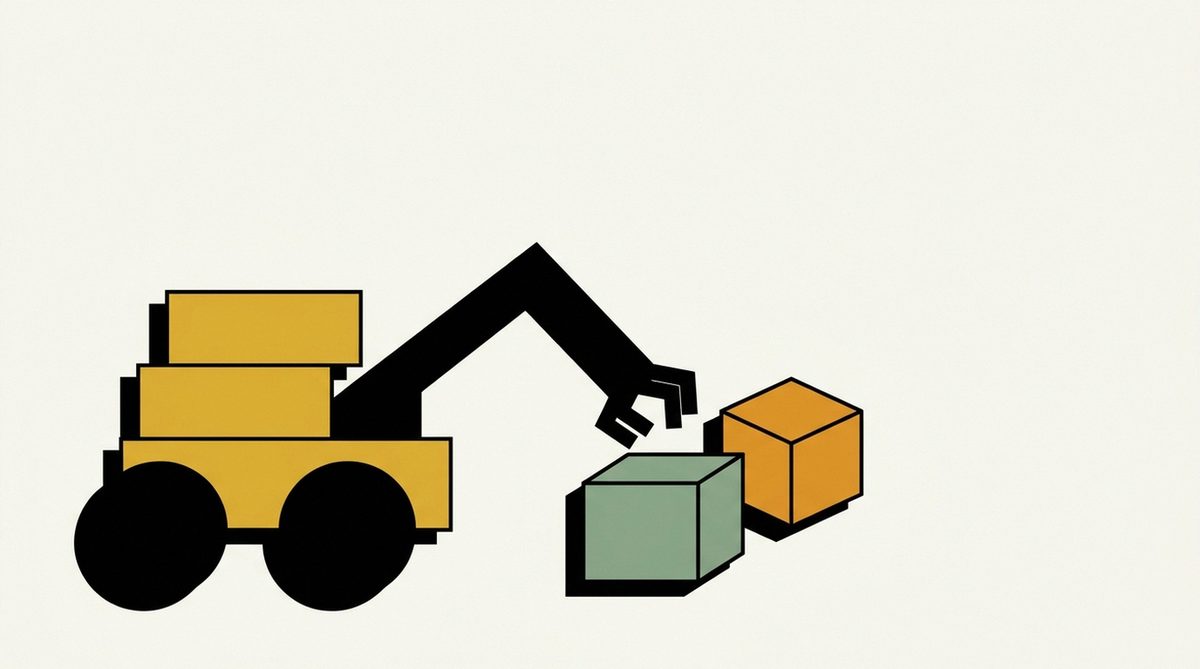
Their robot separated organic waste from non-organic waste. It ran on wheels, drove forwards and backwards, and opened doors to throw the rubbish away. The pupils controlled it with advanced Pocket Code and Create@School blocks, used the phone's own sensors to direct it, and integrated the LEGO sensors so it could detect obstacles as it moved. They added text, voice, images and colours, because a robot has to be explained as well as demonstrated.
The competition, as the evaluation describes it: coaches guide candidates aged 10 to 16 to research a real-world problem connected to their own interests, recycling among them, then design, build and program a robot with LEGO MINDSTORMS on a table-top playing field. Its Open European Championship hosts more than 90 teams from more than 80 countries. The Úbeda team came second in the local championship of Granada, went through to the provincial league, and won the award for robot designers and the award for young promise.
- School Úbeda, Andalusia, one of two Spanish pilot schools
- Setting Extracurricular, within a programme for high-attaining pupils
- Hardware School LEGO NXT and EV3 kits, plus mobile devices
- Coding Advanced Pocket Code and Create@School blocks
- Result Second in Granada, then through to the provincial league
- Awards Robot designers; young promise
What made it work
The authors read this as validation of the app outside the school walls, code connected to sensors in real objects rather than only in the phone, and work still tied to curriculum content, since recycling belongs to science. They add that the outcome mattered less than the process. That is as far as the paper goes; what follows is ours, from teaching rather than the evaluation.
The problem was real, and it was theirs. Sorting waste has no answer at the back of the book, and nobody in the room could say whether the team's approach would work. Children can tell a task set to be marked from one whose answer is genuinely unknown, and they work differently on the second.
The deadline and the audience came from outside. A competition date does not move because a teacher is ill or the term ran short, and the judges had never met these pupils. Work for your own teacher can be negotiated; work for strangers on a fixed date cannot.
It needed several kinds of competence at once: a chassis that held together, some thought about how waste actually gets sorted, the blocks themselves, and somebody willing to face the judges and explain it. A child who is not the strongest coder still has a real job. In a coding exercise, coding ability decides who is good at the task. Here it decided one role of several.
The feedback was physical. The robot either picked up the bottle or it did not. Code that is nearly right produces a machine that visibly fails, in front of the child who wrote it, and can be fixed and tried again at once. No marking scheme matches that.
And it ran outside lesson time. The classroom half of the same pilot is a catalogue of constraints: Wi-Fi that collapsed when a class connected at once, security settings that blocked the images pupils needed, and apps pupils treated as a school resource because the school had chosen them. Those are timetable problems as much as technology ones. An after-school team has the afternoon and chose to be there. The paper does not draw that contrast; we are.
What does not transfer
This was not a bare classroom with phones in it. Four things were in place before the first block was dragged: a programme for high-attaining pupils, LEGO kits the school owned, an adult coach with time, and a competition with a local round close enough to reach. Remove any one and the story changes.
Robotics kits also cost money. We will not quote a figure, because the paper gives none and a 2015 price would be no use now, but a school with a cupboard full of them starts somewhere a family does not.
Nor does every child want a competition. Some are lifted by a fixed date and a public result; for others that is exactly what ends a project before it starts. These pupils were also selected for a programme for high-attaining children; what the same brief does to a mixed group, this pilot does not answer.
The smaller version, without a kit or a championship
Strip out the robot and the trophy and four things survive, none of them expensive: a problem the child picked, a deadline somebody else set, an audience that is not you, and enough separate jobs that a second person is useful.
The problem has to annoy the child, not you. “Make a game about recycling” is a school topic; “the bins in this house are confusing and Dad always gets them wrong” is a grievance, which works. The phone is already the sensor kit: accelerometer, gyroscope, light and GPS, all read directly by Pocket Code, as our piece on thephone full of sensors sets out.
For the deadline, use a date already in the family calendar: grandparents on Saturday week, a cousin's birthday, a friend coming over. The audience is whoever that date brings, as long as they will try the thing and say what happened. Keep the scale honest, two weekends rather than a term, and expect it not to finish. Our piece ontelling consuming from creating covers what an abandoned project usually means.
What we cannot tell you
The evaluation gives this strand about a paragraph, so we do not know the team's size, how long they worked, or how much the coach did. Nor do we know whether anything comparable happened at the other pilot sites: three evaluation studies were planned, one per country, and only the Spanish one has surfaced.
The largest limit is that this study measured acceptance and user experience, not learning. Nothing in it shows the Úbeda team understood more science than a class that never built a robot. What it shows is that some children chose a problem, built something to solve it, took it out of the building and were judged well by strangers. That is a narrower claim than it sounds, and in our experience still the rarer one. More of what parents ask us is on theAt-Home hub.
Source. Gaeta, E.; Beltrán-Jaunsaras, M. E.; Cea, G.; Spieler, B.; Burton, A.; García-Betances, R. I.; Cabrera-Umpiérrez, M. F.; Brown, D.; Boulton, H.; Arredondo Waldmeyer, M. T. “Evaluation of the Create@School Game-Based Learning–Teaching Approach.” Sensors 2019, 19(15), 3251.doi:10.3390/s19153251
Open access under CC BY 4.0. The full text is free to read at Europe PMC:PMC6695907.